Sunday, February 10, 2008

#C2 Pan-Asian Masala Chai recipe

Here is a set of instructions for making chai. Since spice can steep for longer than tea, the preferred approach is to steep the spice first, for 3-5 mins, then steep the spice and tea together, for another 3-5 mins. Therefore, your ELEMENT SPICE chai compound does not have the tea mixed in, as many chai mixes do, which prevents proper steeping. A basic black tea like Assam or Nilgiri would work well. I recommend that you add boiling water in two stages so that the water is still properly hot (near boiling) when it comes time to steep the tea. The cups in the photo, by the way, are small, thin clay cups that are treated as disposable in India, and are commonly used by the vendors selling chai on the railways.

ELEMENT SPICE COMPOUND #C2
Pan-Asian Masala Chai (spice only)
Inspiration: South India

There is no one Masala Chai (Hindi for “spice mix tea”) recipe, but cloves, cardamom and cassia cinnamon are almost universal. Because spices take longer to extract than tea does, the best way to prepare your chai is to first steep the spices for about 5 minutes, then add the black tea and steep for another 3-5 minutes. The standard price for a glass of Masala Chai from the chai-wallahs on the streets of India, whether in rural areas or the cosmopolitan cities, is 2 rupees (5 cents). Our pan-Asian version adds star anise (used in India, but more common in Southeast and East Asian cooking (e.g., Chinese five-spice) and ginger. A tea ball, strainer, or other tea-making device can be used to make your chai. A French press can also work, though we recommend decanting your chai immediately after it steeps, because French presses usually do not stop extraction of tea.

(1) Shake or mix Pan-Asian Masala Chai spice. Optional: toast the spice, just to the point of smoking.

(2) Measure out one heaping teapoon (7 ml) of Masala Chai spice and one heaping teaspoon of loose black tea for each cup of water, 8 fl oz (120 ml).

(3) Steep the Masala Chai spice for 5 minutes, then add the loose black tea for another 3-5 minutes. Ideally, the water should be near boiling at both stages, so boil water and half the needed amount for the spices, then reboil the water while waiting for the spices to steep and add boiling water again at the tea stage.

(4) Decant the liquid or strain out the spice and tea leaves. Add milk and sugar to taste (to do it in true Desi style, add a lot of both). For a refreshing change, try it without the milk and sugar, or even without the tea!

INGREDIENTS: Cardamom, cassia cinnamon, cloves, star anise, ginger, black pepper.

Information on tea and tea plantations:
The Republic of Tea
Meghma Tea Estate

Saturday, February 9, 2008

#C1 Mustard Masala Rub recipe

Since Blogger has a good search interface (thanks Google), I am going to start posting recipes for the ELEMENT SPICE compounds on the blog here, rather than keeping a linear list on the main website. Let's see how it goes. This is a picture of a 10 lb (5kg) chinook salmon I caught, with the filet on the left done with this recipe.

ELEMENT SPICE COMPOUND #C1

Mustard Masala Rub
Inspiration: North India

This rub is a natural for salmon. It also works with trout, mild white fish, or grilled vegetables.

Because salmon fillets are thin, the cooking can be done on just one side, though you can cook on both sides and halve the cooking time for each. The recipe below is for an oven broiler, though it can be done on a grill as well. Salt and apply the spice to the salmon up to 30 min to 4 hours before cooking. The rub will result in a “medium spicy” fillet. For “extra spicy,” add black pepper before serving.

(1) Coat the salmon fillet with a light, high smoke-point oil such as canola oil. You can use a brush, the back of spoon, or drizzle a little oil in a metal bowl and toss the fillet in it.

(2) Place the fillet skin side down.

(3) Salt the top of the fillet with a flaky salt (sea or kosher salt) to taste, in order to draw out some of the juices and form a crust.

(4) Shake or mix Mustard Masala Salmon Rub well. Place one heaping teaspoon (7 ml) per 6 oz (170 g) serving in a bowl. Drizzle with oil and mix to form a thick paste.

(5) Spread the paste on top of the fillet.

(6) 30 minutes before cooking, remove the fillet from the refrigerator and transfer to the cooking surface (such as a sheet pan) skin side down.

(7) Broil in the oven to the desired doneness, according to the chart below. Set the rack so the fillet is 8-10 inches (20-25 cm) from the broiler. In most ovens, salmon will be medium rare in about 6-8 minutes, at which point it will begin to flake apart when tested with a fork. Monitor to avoid excessive blackening of the spices.

Rare: 120ºF / 49ºC
Medium Rare: 125ºF / 52ºC
Medium: 130ºF / 54ºC
Well Done: 135ºF / 57ºC

INGREDIENTS: Black and yellow mustard seed, coriander, onion, fennel seed, cardamom, cumin, brown sugar, kosher salt, black pepper, cayenne pepper.

In the North American West, from Northern California all the way to Alaska, we have the privilege of widely-available, sustainably-fished, wild Pacific salmon. Better tasting, better for you, better for the community and environment. Try it!

Some resources we like:
Lummi Island Wild Salmon
Alaskan Wild Salmon Company
Salmon Nation
Monterey Bay Aquarium Seafood Watch Program


Tuesday, January 29, 2008

Marin County, California

My brother Bill lives right on Tomales Bay, near Pt. Reyes National Seashore in Marin County. West Marin is a phenomenal locus for local food. His house is steps away from Manka's, and right across the bay is Tomales Bay Oysters. I hope to lead a group of kayakers across the bay for an oyster BBQ as an Element Spice culinary event this spring or summer. Two other oyster farms, including the renowned Hog Island Oysters, are also in the area.

Oyster farming is consider the height of ecologically sound aquaculture practice, in addition to being a real treat. Since oysters are sessile organisms in the wild anyway, they are just as good, if not better, farmed. The Monterey Bay Aquarium Seafood Watch gives farmed oysters a green rating.


Bill went mushroom foraging this weekend, and got quite a haul of funnels, funnel chantarelles (yellow foots) , honey mushrooms and hedgehog mushrooms (the good are in this picture). Mushroom foraging is a bit scary, but he's a level-headed guy and plays it safe.


I picked up a copy of Marin Farm Families, Stories and Recipes, which was published by the Marin Agricultural Land Trust (MALT) last time I was in the area (at Toby's Feed Barn, in the town of Pt. Reyes Station). Much more on the culinary treasures of West Marin later.

Speaking of foraging, this video shows one of my favorite ways of getting a meal in Northern California, abalone diving. It's actually pretty easy for me, as I can hold my breath for six minutes.

San Francisco, California

I stayed in San Francisco's Fisherman's Wharf last night. Yeah, it's a tourist trap, so I won't say much about it.

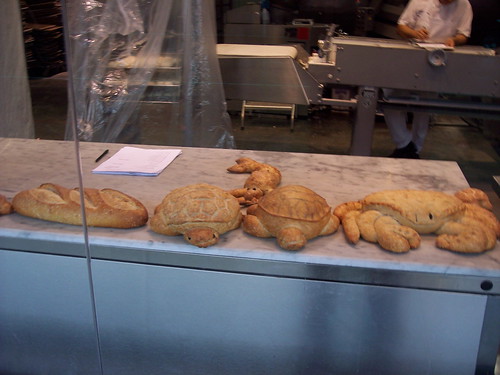
The Boudin Bakery at the wharf does make sourdough loaves in the shape of Dungeness crabs which I find quite amusing, since I am crazy about the little buggers. The recent oil spill in the SF Bay threatened the local crab harvest for a while.

I also had dim sum at Yang Sing in
Rincon Center, which is historic downtown Art Deco building cum food court. The center has some Diego's Rivera-esque murals, though as a culinary blogger, I do have to nitpick the Atlantic lobster shown under the Golden Gate bridge. :)

Saturday, January 26, 2008

Ponche (Mexican Drink) recipe

INGREDIENTS:

hard crystal sugar
2-3 cinnamon sticks
4-5 pieces sugar cane
4 fresh tejocote
5-6 jamaica
3 guava
2 apples (green and red)
dry prunes
3 tamarindo
2 quarts water

(1) place half the crystal sugar cone and cinnamon sticks into boiling water until sugar is dissolved
(2) chop up all other ingredients except the prunes (note: you should peel the outer layer off the tamarindo)
(3) add all the ingredients into the boiling water
(4) bring temperature down low and simmer until the color goes out of the apples...about 1 to 2 hours
(5) enjoy!

it is traditional to enjoy Mexican Pnoche with a little tequila added

Silicon Valley, California, Cultural Wasteland?

I've been spending a lot of time in Silicon Valley recently. I know that the smartest and most innovative people in the world are here, but it's also an interminable, featureless suburb. I've been staying in Menlo Park, and the best thing I can say about my area is that it is right next to a huge Mexican enclave. The area centers around Middlefield Road and is anchored by
Chavez Supermarket. There are all sorts of Mexican restaurants and shops, including several Mexican seafood joints within a stone's throw of each other. After a late night at the office, I often stop by Tacqueria El Grullense, the local late-night burrito chain and browse the bilingual newspaper El Reportero, which has all articles in both English and Spanish.

The local gourmet grocery mart, Sigona's, carries a whole host of dried fruits, as well as Mexican produce such as tejocote, nopales (cactus), mescal (sugar cane) and tamarindo. They recently featured a recipe for the Ponche (see next post). Menlo Park also features the ultra-gourmet supermarket Draeger's, which is famous for purveying balsamic vinegars costing hundreds of dollars.

Thursday, January 24, 2008

Berkeley, California

I lived in Berkeley for many years, and always enjoy going back, as I did this weekend. Whenever I am there I can't resist stuffing my face-- it has so much to offer the foodie. I will write a lot more about Berkeley in this blog. One of the newest additions to Berkeley's gourmet ghetto is the Epicurious Garden, where I had ivory salmon nigiri at Kirala. On this trip I also stopped by Vik's Chaat House for samosas and picked up a kulich loaf (Russian Easter Bread) at Acme Bread Co. Vik's has associated warehouses. both retail and local, where most of the local Indian restaurant get their supplies. It's where I get my spices for the time being. On this trip I scored cassia and true cinnamon, black sesame, brown and yellow mustard seed, cloves, fennel, black pepper and cardamom seed (w/o the pods).

I just learned about a new place in Berkeley called Three Stone Hearth, which is a community supported kitchen/catering service. I can't wait to check it out, maybe volunteer for a day in the kitchen or attend a full moon feast.

Monday, January 21, 2008

The choice between feeding our SUVs and feeding children in the Third World?

While I am all for low or non-polluting renewable energy, the recent hype with biofuels should give us pause. Regarding corn ethanol in particular, we should realize that anything having to do with corn is more about federal boondoggles than it is about producing food or anything else useful. Some believe that the fossil fuel inputs to corn (fertilizer, tractors, transport cost) actually mean it takes more gasoline to produce corn ethanol than the ethanol can replace. Rolling Stone often publishes great articles on non-music subjects, and The Ethanol Scam is one of them. Another such article is the one on Pork's Dirty Little Secret.

The recent rise in the price of oil has resulted in a significant rise in the cost of food for those in extreme poverty (by Jeffrey Sachs' definition, those living on less than about US$1 a day), as discussed in The Economist and The New York Times. Did you know, by the way, that NYT has a permalinking function aimed primarily for bloggers but open to everyone (just go to the share menu next to each article)? Many of the articles in NYT are archived after a week, after which access must be paid for, unless the article is permalinked by an outsider. The permalinking function shows that NYT is ambivalent about charging for content. Are they wrestling with The Pirate's Dilemma?

Sunday, January 20, 2008

Slow Food, Mindful Growing, Cooking and Eating

The WHO recently reported that the number of people malnourished from overeating has surpassed those that are malnourished from under eating. Neither is good, but at least those of us that have too much food to eat can choose to eat less. And to eat better. Slow food and local food can be a big part of this. And if we make growing, foraging and cooking, as much of the process as eating as possible, we'll be eating and living healthier, and eating better tasting food too. Mindful eating is better for you and the planet than stuffing your face. I recommend Gary Nabhan among others, for furthering reading on slow and local food. Oh, and I just read this article about Martha's Vineyard in the NYT.

Saturday, January 19, 2008

Eat food. Not too much. Mostly plants.

That is the pithy and rather complete advice that Michael Pollan gives about easting in the beginning of his NYT article, Unhappy Meals. This article is the best existing narrative on how industry, science and the media has has taken the acts of preparing and eating food, which should be simple, joyful, and nourishing and appropriated them for their own ends. In Defense of Food is an expanded book version of the article, though if you don't have time to read the whole book, the article will suffice. Pollan's The Botany of Desire, however, is a must read.

One of the food hegemonies that Pollan's dissects is what he calls nutritionism. Foods are complex and wonderful things. Since we don't really understand them, we should stop adding supplements to and making dubious health claims about foods, especially since the very act of modifying/manufacturing foods makes them something less than real. Marion Nestle calls the majority of products that crowd our supermarket aisles these days "edible food-like substances."